The Indigenous identity challenge
Removing blood quantum is not the hard part; What’s next is the hard part.

Weekend Newsrime
Here’s something we already knew:
We pay nearly all of the tariffs due
Of course tariffs are only the disguise
they’re really taxes that we despise
The Federal Reserve Bank of NY has the receipts:
“First, 94 percent of the tariff incidence was borne by the U.S. in the first eight months of 2025. This result means that a 10 percent tariff caused only a 0.6 percentage point decline in foreign export prices. Second, the tariff pass-through into import prices has declined in the latter part of the year. That is, a larger share of the tariff incidence was borne by foreign exporters by the end of the year. In November, a 10 percent tariff was associated with a 1.4 percent decline in foreign export prices, suggesting an 86 percent pass-through to U.S. import prices. Given that the average tariff in December was 13 percent (see the first chart), our results imply that U.S. import prices for goods subject to the average tariff increased by 11 percent (13 times 0.86) more than those for goods not subject to tariffs.”
Indigenous identity
Last week I was on a panel at the American Indian Studies Association conference at the University of New Mexico. It was serendipity. Suzan Harjo asked me to join a few weeks ago, and as it turned out, Jaynie and I made a quick drive across the country for family reasons (Boston to Phoenix) — so I was able to be there in person.
Of course Suzan organized an amazing panel. The lineup:
Identity and Recognition as Family and Belonging will be a hybrid panel, with some participants there in person and some joining virtually. Chaired by Lloyd L. Lee, Ph.D., is an enrolled Citizen, Navajo Nation; Kinyaa’áanii (Towering House), born for Tł‘ááshchí’í (Red Cheeks); his maternal grandfather’s clan is ‘Áshįįhi (Salt); and his paternal grandfather’s clan is Tábąąhá (Water’s Edge). The panelists include: Philip J. Deloria, Ph.D. (Yankton Dakota), Dalee Sambo Dorough, Ph.D. (Alaskan Iñupiaq), Stephanie Fryberg, Ph.D. (Tulalip Tribe), Suzan Shown Harjo, L.H.D. h.c., & D.Hum. h.c. (Cheyenne Citizen, Cheyenne & Arapaho Tribes, and Hotvlkvlke Mvskokvlke, Nuyakv), Norbert S. Hill, Jr. (Citizen, Oneida Nation), Tina Kuckkahn, J.D. (Citizen, Lac du Flambeau Band of Lake Superior Ojibwe, with family affiliation with the Lac Courte Oreilles Band, Lake Superior Chippewa Indians), Brett Lee Shelton, J.D. (Oceti Sakowin Oyate, enrolled Oglala Sioux Tribe) and Mark Trahant (Citizen, Shoshone-Bannock Tribes).
I thought I would expand, a bit, on what I talked about.
First a shout out. I was recently listening to a couple of Canadian professors talk about Phil Deloria’s book, “Playing Indian.” They used the book in their class as part of their curriculum and lamented that there is not a Canadian edition. But it’s so good — they use it anyway. I was struck by this for a couple of reasons. First, it’s not a new book, I remember reading it years ago. And, second, this a historical take that is often missing from current debates about psedo-Indians. None of the debates about identity (real or fake) are new.
Back to Albuquerque and the panel. I am going to focus on one segment of the conversation, the citizenship process. One of Suzan’s points is that the identity issue is a political problem in our own nations. Thus the solution will be from each community on its own terms. “Native people are trying to change constitutions that have been imposed on us, and stupid things like blood quantum,” she said. “We need to think long and hard about that” starting with a framework based on “our values.”
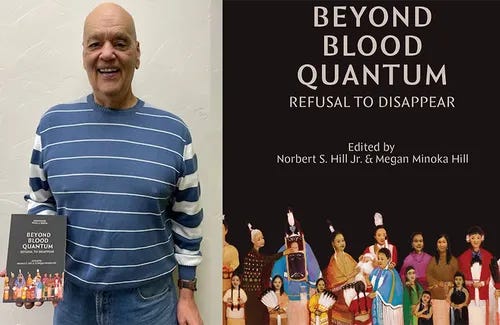
Norbert Hill, is co-editor of the book “Beyond Blood Quantum: Refusal to Disappear,” said more than four hundred tribes are wrestling with the citizenship and identity issues, shifting away from blood quantum to conversations about relationships, belonging and community. Unless there is a change, there is a “mathematical” certainty that tribes will not have a future.
From the book:
“Removing blood quantum is not the hard part; the question of what’s next is the hard part. While there is no single answer that will fulfill the needs of every tribe, each has the power to excercise sovereignty and draw their own community maps.”
This is the context for when I joined the conversation at the end of the panel. (Because the session was almost over, I said at the time, I would write this down, and post it for later consideration.) Then the idea of talking about “identity” or “citizenship” in less than ten minutes would be no less challenging than trying to explain my thoughts in twenty or minutes.
When I was a teenager, I was helping my dad clean out an attic, when he found a box of old newspapers. Sort of newspapers, they were 8x10 stencils of a publication called the Shoshone-Bannock Tevope published in the 1930s. “Tevope” means paper in Shoshone and it was edited by a remarkable tribal leader, Ralph W. Dixey.
The words seemed written for me:
“Friends, we are all Indians no matter how white or dark we are. It does not make any difference where you are, what you are doing, or how much money you are making. We are all Indians. Our chiefs calls us half-breeds and we call them darn fools. Now who is right? We are both wrong. We are all Indians.”
Here I was, trying to figure out who I am, and my place in the world, and I was reading a debate from the 1930s that had a similar thread. Now, some fifty years later, I wonder about the same things for my grand children. How do they fit in? How do they think they fit? What does citizenship look like a decade from now? Or fifty or a hundred years forward?
A couple of years ago Meghan Sullivan re-examined the Alaska Native Claims Act for its 50th anniversary for ICT. The whole series is amazing, but I was really moved when she wrote about identity.
She quoted Delaney Naruyaq’ Theile, Dena’ina Athabascan and Yup’ik.
“We’re the only group of people that have to think about: who do we marry? Who do we have our kids with if we want to keep our lands and our rights within our community It’s something that weighs heavily on a lot of my friends.”
This is a great example of how complicated this all is. Alaska Native? Dena’ina Athabascan? Yupik’?
And what about those young people who are neither shareholders in a regional corporation nor enrolled in any village?
Across all our communities, this generation has the additional burden of the math. How do you account for multiple tribes, some requiring blood quantum, some with descent, and some, like mine, that also include geographical or residency restrictions? Or even a generational rank: I inherited a small slice of trust property because I am the oldest sibling and cousin.
What will Indian Country look like in the future?
One of the problems is that we don’t have good data. The US Census is useless. What we need to know: The number of tribal citizen being born compared to the number of tribal citizen who die each year. The number is unique to every tribal community, and here’s the thing, the long term demographic trend is destiny (whether known or not).
One of the most interesting experiments are when tribes, such as the Crow Nation recently, reset the clock on blood quantum and declare every citizen 100 percent. (When you think about it: Every citizen is just that, 100 percent. You are a citizen or you are not.)
Many nations around the world, including Canada, open up a process for citizenship based on a single grandparent (some even go beyond that, great-grandparents.) The rules are country by country and complicated.
But the key point is these are political solutions, built around sovereignty and community identification.
A few years ago I had a conversation with the attorney general for the Navajo Nation. We were talking about the Navajo Nation as a potential state and what that would look like. On the citizenship question, for example, would that mean the Navajos would have to come up with a process for naturalization? What does one have to know to be a citizen? The basics of government? Language? Culture?
How will we determine the next generation?
Many of our grandchildren grow up far from our community and are missing out on that routine of community and ceremony. Could they later study to be citizens (which they already might be) but better, good citizens?
(Consider the Governor of Oklahoma proclaiming his Indianness to snickers from tribal leaders and tying to tie that to DEI? So ignorant. He certainly could use those history lessons in order to be a good citizen.)
Writer and poet, R. Vincent Moniz, Jr., recently wrote in his Substack, The News So Far, about the “Mythic Mathematical Extinction” and how blood quantum means enforcing your own extinction. In a follow-up text message, he said what if there was a way to solve the math crisis and the cultural crisis at once. “Not with a test, but with investment,” he said. What if enrollment included resources? Language funds. Mentoring. Homecoming trips. “The nation saying, ‘we’re bringing you home,’ instead of ‘prove you belong.’”
One more story from our drive across the county. We visited friends in Oklahoma and were invited to hear a presentation by a young man speaking about the use of fire.
His talk was fascinating, but even more inspiring was the rest of his story. He later told us about his weekly lunch with elders, speaking only Chickasaw. He has been doing this for years.
Perhaps that’s how identity issues will move forward. Not from regulations. But from real investments by people and communities who are determined to find a way to carry the people forward.
This is the future I want for my grandchildren.
I’m reminded of a conversation between the Wendat diplomat Kandiaronk and a Frenchman exhorting him to “become a Huron”, after pointing out all the ways his indigenous culture was superior to the Frenchman’s.
If a Frenchman could “become a Huron”, what exactly is “identity”?
I don’t think that the normative laws of the West can sort out issues within traditional cultures. Colonization has left us with systems created by those who never sought to learn, let alone understand our cultures or for that matter what ‘culture’ is. These laws were not made to let people flourish. Their purpose was to control the people, keep them in check if not wipe them out. As Western culture wanes, swallowed up by its own unresolvable contradictions, it’s important for traditions around the world to examine and inform our experience of culture.
I’ve been intrigued by the work of Belgian philosopher Balu, who researches cultural differences. He claims that cultures are “configurations of learning”. If you look at it that way, the question of bloodline does not apply at all to this issue. Even a Frenchman could “become a Huron”.
A non-Native friend I used to hang out with in Albuquerque always marveled at how quickly I could recognize other Native people and determine their tribal affiliations while striking up conversations. He was also intrigued by how interconnected we are and how much we share in common regardless of tribal affiliation.
"How can you tell they're Native?" he once asked.
"You know when you know" I replied.
So simple for us to understand but nearly impossible to explain to someone else.