
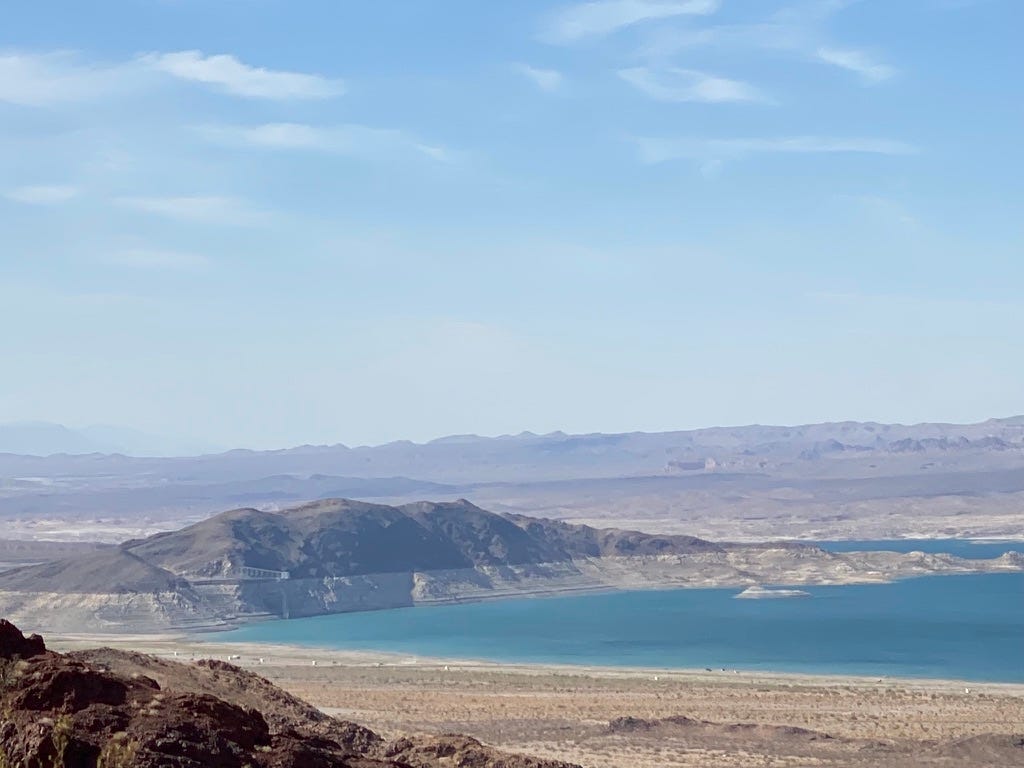
An old school way of measuring water at Lake Mead.
What data can do
A few thoughts that I will toss out today at the Data Sovereignty and Governance Summit today in Tucson.
We in the journalism community need to teach and incorporate better data skills. We need to think about data as an essential part of storytelling.
In tribal nations, data is our history. I think about petroglyphs and winter counts as evidence that we have always used data to tell stories.
Perhaps there was a scholar working a thousands of years ago. Look at a blank rock. Think. Walk. Make coffee. Clean. Do anything except write. Sharpen that rock again. Thinks some more. And, when finally out of excuses, start the rock art.
Humans are funny that way. Will machines be better? Not likely. They will have to wait for us to come up with the framework. Ask the right questions. So we’ll still be making coffee as fast as our excuses.
Here are a few data stories that I think are worth considering.
A new winter count. Machine Learning opens up new routes. So what if tribes (especially using enrollment data) build our own census models. This could be used to design services … and to challenge the federal government’s count.
Land reform. The purchases of fractionated land under Cobell was not enough. There are still far too many pieces of land (and other resources) with too many owners. I am about a 1/3000th owner of an oil well. (My monthly checks are in the low two figures, enough for a single lunch.) What if we could use Machine Learning to measure and create a market for these fractionated shares? Or could tribes use the data to buy and consolidate land holdings? The fractionation of land is a data problem that compounds every year and it will only grow more complicated and difficult to untangle unless it’s addressed.
Salmon and other species restoration. We have been collecting data on salmon for a long time. But Machine Learning opens up new alternatives in terms of making that data useful. Think about enough data to follow one fish through its cycle, then comparing options at each stage (what if fishing is allowed here, etc.?) What can we learn at this point from hatchery, wild runs? Dam removals? River temperatures?
Tribes hosting data centers. There is a backlash against data centers — and Indian Country is a part of that. The arguments against data centers are solid. But there are two considerations that should also be included, first, how do we use water now? And, second, why do we need data centers as currently constructed?
We need to rethink water (another project for Machine Learning). Agriculture uses roughly 80 percent of consumptive water in the West — and even the massive amounts of water for data centers will not change that. So much of our agriculture consumption is wasteful. In Arizona, for example, a lot of water is used growing hay in the desert. Last year Arizona exported 350,000 metric tons of hay, just less than 20 percent of the crop that sold for $167 million to China, Saudi Arabia and Japan. Across the parched West that figure reaches 1 billion in international hay sales. I personally worry about the way the mining industry uses (misuses) water. But the hard fact is that it only totals about one percent of water use.
We need to know the score and then redirect our tools toward efficiency. This can be done because there are so many ways that water efficiency could be improved. (Don’t get me started on how much energy, water, and calories are needed to support a cow.)
Data centers use a lot of water because it’s a cheap way to cool heat from the machines. The way to stop that practice is to make water more expensive. The industry itself, then, will find new ways to go forward.
(And if tribes are in the mix for location, then tribal governance can play its role too. Tribes can require good water use.)
One innovation to watch is Microsoft’s Project Natick, a data center that is submerged near the Orkney Islands. That’s not the only water reduction project. It won’t be long before their are best practices that can be modeled.
Data sovereignty is not just about information, but it’s also about how the rules are drafted. And if a data center is on tribal lands, it will be a tribe writing those rules.
Today’s Newsrime
How much are you will to pay?
$10 a gallon before you say nay?
Demand destruction has already begun
That’s when folks fold and say we’re done
The International Energy Agency report looks at demand destruction. When does the price of a tank of gas force a change in driving habits, consumption?