Back to a White House future
Shout out to the bureaucrats (public servants)

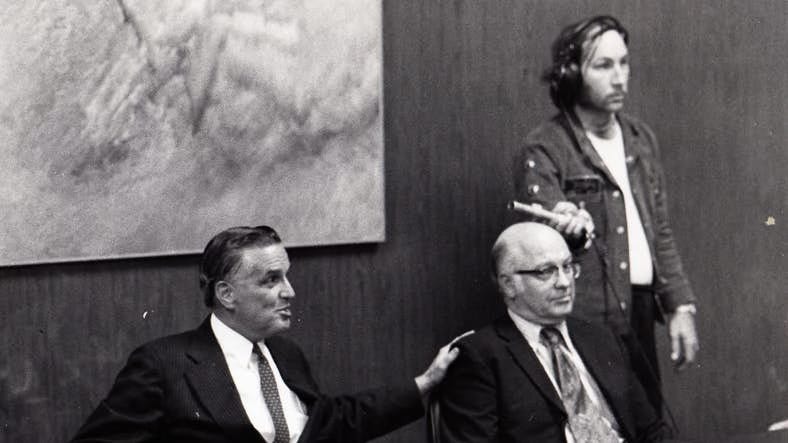
Brad Patterson during the takeover of the Bureau of Indian Affairs with Interior Department's Harrison Loesch. (Photo via American Indian Press Association archives)
I have a follow-up to my last post about 1976: It’s worth revisiting the career of Bradley H. Patterson, Jr.
I have been thinking about Brad ever since the Vanity Fair piece was published about Susie Wiles and the inside operation of the White House. Her interview explored the complex and chaotic personalities in the Trump administration, including the president himself. And a disdain for the rule of law on issues ranging from the president’s attack on political opponents to the reckless destruction of international relief agencies.
From the Trump perspective, this has been an effective year. Destructive change.
But there is another model for a White House team. Over the years I have interviewed Brad Patterson about his work and one of the first things he would point out is that he was an independent. He was a proud bureaucrat, a public servant.
One of his first tasks in the Eisenhower administration was to prepare for the incoming John F. Kennedy administration on January 20, 1961.
In an oral history for the Kennedy Library, Patterson explained the process. “President Eisenhower stressed two things … that this change took place suddenly, with dramatic suddenness, at noon on the 20th of January.”
That was the constitutional process. End of story. Except. “On the other side of the coin, however, I think typically is his concern for good administration in government. He was really personally and vitally concerned that the change, when it took place, became a smooth one.”
Patterson played no role in any political campaign. His role at the White Houses was as a “career guy … We were hired, and treated, as career professionals.”
Patterson’s contributions on federal Indian policy are worthy of books. He helped shape Nixon’s Self-Determination policy, pushed the Ford White House to back the Indian Health Care Improvement Act. And was a voice on patience on many of the crisis issues during the 1970s. He was particularly proud to have played a role in return of Blue Lake to the Taos Pueblo.
Praise the bureaucrats!
When the Trump era is over – and we have had enough chaos, there will be a moment when the boring steps called process has a role again.
Patterson once told the University of Chicago magazine that he was proud of the term “bureaucrat.” He said: “These are men and women who serve their country, serve their nation, some of them at great sacrifice, at modest pay, and sometimes for their whole lives. To give them that kind of pejorative appellation bothers me a lot. I’m proud of public service and the men and women in public service.”
After the White House, Paterson served at the Brookings Institution. He wrote several books including “Ring of Power,” “The White House Staff: Inside the West Wing and Beyond” and in 2010, “To Serve the President.”
From “To Serve the President”:
“— Senior staff members are partisans of the president. But their political commitment cannot be allowed to override the intellectual integrity that they must bring to their work. Contrary to public belief, sycophants and crusaders, if tolerated briefly, are not long welcome at the White House.
—Citizens might assume that members of a White House staff are cut from the same pattern on issues of public policy. Wrong. Differences in background, experience, age, gender, race, and especially party faction arc across the White House. The environment is an intellectually electric one, which is to the president’s benefit—unless the internal arguments become ad hominem or are fought out in public.”
We know the pendulum will swing back toward that kind of thinking in the White House. The only question is when.